CleaningOpsPro may earn a commission on some links. Our editorial recommendations are always our own.
The difference between keeping a commercial cleaning contract for five years and losing it after six months comes down to one thing: documentation. Not how well you clean — how well you prove you cleaned. A commercial cleaning checklist is that proof.
Building managers don’t fire janitorial companies because the floors weren’t perfect on Tuesday. They fire them because they can’t tell whether the floors were touched at all. A structured checklist with daily, weekly, and monthly task schedules gives your crew clear direction, gives your client visible accountability, and gives you the paper trail to defend your work when complaints come in.
What follows is the task-by-task breakdown we’ve built from ISSA cleaning frequency standards, production rate benchmarks, and the patterns we’ve seen across dozens of commercial cleaning operations. Time estimates are based on a standard 10,000 sq ft office building with one crew member per shift.
Daily Tasks: The Non-Negotiables
Daily tasks are the baseline your client sees every morning when they walk in. Skip any of these and you’ll hear about it within 48 hours.
Time estimate: 2-3 hours for a 10,000 sq ft office
| Task | Area | Notes |
|---|---|---|
| Empty all trash and recycling bins | Entire building | Replace liners every pull, not just when visibly soiled |
| Clean and restock restrooms | All restrooms | See restroom-specific checklist below |
| Wipe break room counters and tables | Break room / kitchen | Sanitize sink, empty trash, wipe appliance exteriors |
| Vacuum high-traffic areas | Lobbies, hallways, main corridors | Full carpet vacuuming is weekly — daily is traffic lanes only |
| Spot mop hard floors | Entrances, kitchen, restroom floors | Address spills and tracked-in dirt, not full mopping |
| Clean entrance glass | Front doors, lobby glass | Both sides. This is what clients see first every morning |
| Wipe reception desk and common surfaces | Lobby, shared desks, conference tables | Door handles, light switches, elevator buttons |
The daily checklist should take your crew 2 to 3 hours in a standard 10,000 sq ft office. If it’s taking significantly longer, your crew either needs training on efficient movement patterns or the scope of work in your contract doesn’t match the time you’re billing. Both are fixable — but only if you’re tracking time against the checklist. Tools like Connecteam{rel=“nofollow sponsored”} let you assign these daily tasks with GPS time tracking so you can see exactly how long each area takes.
Weekly Tasks: Deeper Maintenance
Weekly tasks prevent the slow buildup that turns into visible grime by month two. These are the tasks clients don’t notice when you do them — but absolutely notice when you don’t.
Time estimate: 3-4 additional hours per week (on top of daily tasks)
- Full floor mopping — All hard surfaces, wall to wall. Move furniture where accessible. Per ISSA benchmarks, damp mopping with a standard 24-inch mop covers roughly 5,000 sq ft per hour.
- Dust above eye level — Tops of cubicle walls, door frames, picture frames, window sills. Use a high duster or microfiber extension pole. This is the task most crews skip until it becomes visible.
- Deep clean restrooms — Beyond daily service: scrub grout, descale fixtures, clean behind toilets, wipe down partitions. See the restroom section below.
- Break room appliance interiors — Microwave interior, coffee maker, refrigerator shelves (remove expired items with client permission). Exterior wipe-down is daily; interior is weekly.
- Stairwells — Vacuum or sweep all treads, mop landings, wipe handrails, spot clean walls. Stairwells are the forgotten zones in most buildings.
- Dust all horizontal surfaces below eye level — Baseboards, chair legs, under-desk areas. Rotate by zone so every area is hit at least once per week.
Schedule your weekly tasks on a specific night and communicate that schedule to the client. “Deep mopping happens every Wednesday” sets expectations and prevents the “I noticed the floors looked dirty on Thursday” conversation.
Monthly Tasks: Preservation Work
Monthly tasks are about protecting the building’s surfaces and preventing long-term deterioration. These are also the tasks most likely to require specialized equipment or additional crew hours — factor them into your commercial cleaning bid accordingly.
Time estimate: 4-8 additional hours per month depending on building size and finishes
| Task | Details | Equipment Needed |
|---|---|---|
| Floor stripping and waxing (VCT/LVT) | Strip old wax, apply 3-4 fresh coats. Rotate by zone — full building takes multiple sessions | Floor machine, wet vac, stripping solution, finish |
| Interior window cleaning | All interior glass including partitions and office windows. Exterior is typically a separate contract | Squeegee, window solution, microfiber |
| Vent cover cleaning | Remove HVAC vent covers, wash, dry, reinstall. Vacuum inside vent opening | Step ladder, bucket, brush |
| Light fixture cleaning | Wipe diffusers and fixture housings. Note any burned-out bulbs for client maintenance team | Step ladder, microfiber, all-purpose cleaner |
| Carpet extraction (hot water) | Full carpet cleaning on a rotational basis. High-traffic areas monthly, low-traffic quarterly | Carpet extractor, pre-spray, defoamer |
| High dusting | Anything above 8 feet — ceiling corners, top of shelving units, structural beams | Extension duster, ladder |
Monthly tasks are where inexperienced companies lose money. If your contract doesn’t explicitly account for floor care and carpet extraction hours, you’re doing them at a loss. According to BSCAI (Building Service Contractors Association International), floor care is the most commonly under-bid service category in commercial cleaning contracts.
Restroom-Specific Checklist: Where 80% of Complaints Originate
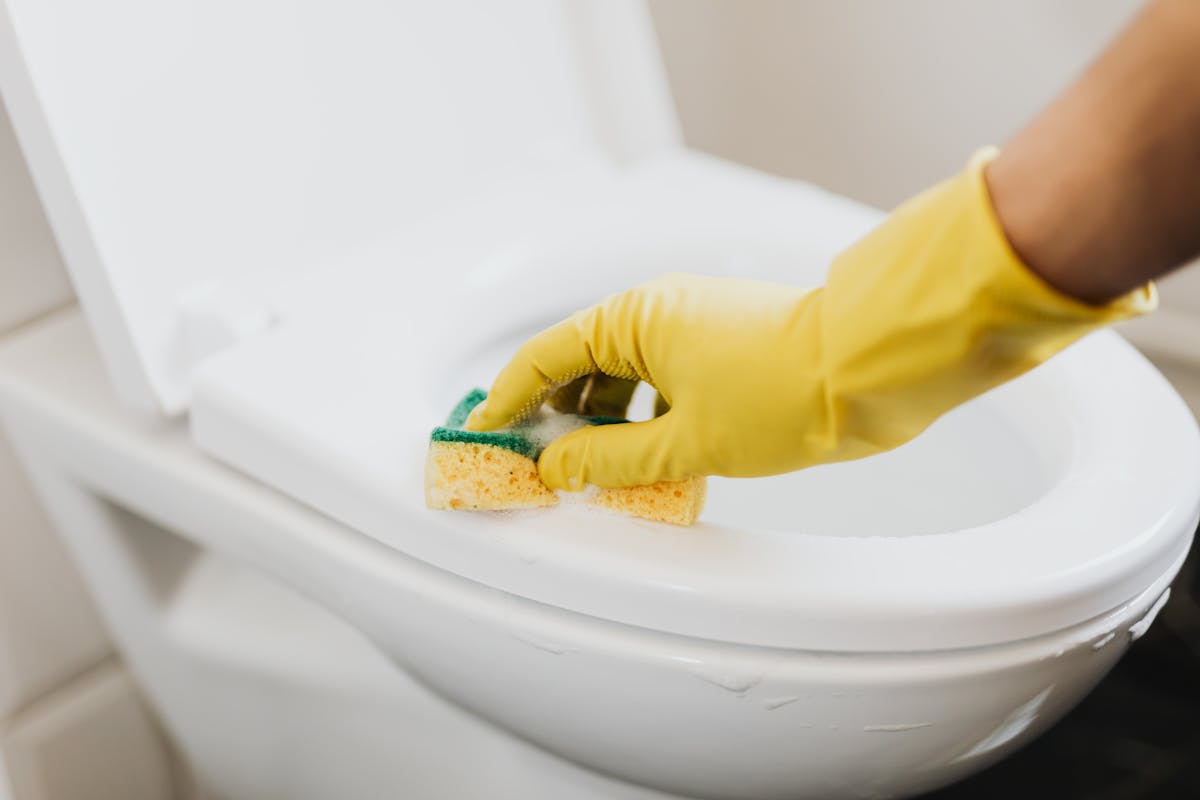
Restrooms generate the vast majority of facility complaints. A building manager who never mentions your vacuuming will call you within hours of a restroom issue. This area deserves its own dedicated checklist.
Daily Restroom Tasks
- Clean and sanitize all toilets and urinals (inside bowl, seat, base, handle)
- Clean and sanitize sinks, faucets, and countertops
- Clean mirrors (streak-free)
- Restock paper towels, toilet paper, seat covers, soap dispensers
- Empty trash and sanitary bins, replace liners
- Spot mop floors around fixtures
- Wipe partitions at handle height
- Check and refill air fresheners
Weekly Restroom Tasks
- Scrub grout lines on floors and walls
- Descale all fixtures (faucets, flush valves, drains)
- Deep clean behind and around toilets
- Wipe all partitions top to bottom
- Clean exhaust fan covers
- Polish any stainless steel surfaces
Monthly Restroom Tasks
- Machine scrub tile floors
- Deep clean and reseal grout (if applicable)
- Inspect caulking around fixtures for mildew
- Clean light fixtures and diffusers
The ISSA recommends calculating restroom cleaning time by counting each fixture (toilet, urinal, sink) and multiplying by approximately 3 minutes per fixture for daily service. A restroom with 4 toilets, 2 urinals, and 4 sinks requires roughly 30 minutes for a thorough daily clean. Factor this into your crew’s nightly schedule — don’t let restrooms get squeezed into the last 10 minutes of a shift.
Building the Inspection System That Keeps Contracts
A checklist tells your crew what to clean. An inspection system proves they cleaned it. The difference matters when a client questions your work — and eventually, every client questions your work.
Pre-Clean Walkthrough (5-10 minutes)
Before your crew starts, the shift lead walks the facility and notes existing conditions. Stain on the conference room carpet? Note it. Overflowing trash from a late meeting? Note it. This protects you from being blamed for problems you didn’t create.
Post-Clean Photo Documentation
Take timestamped photos of completed work in key areas: restrooms, lobbies, break rooms, and any areas with previous complaints. This takes 3-5 minutes at the end of a shift and has saved more contracts than any cleaning technique.
Jobber’s job forms{rel=“nofollow sponsored”} let you create custom inspection checklists with required photo uploads — your crew can’t mark a task complete without attaching a photo. That level of documentation is what separates a $10K/month contract holder from a company that loses bids to lowballers.
Client Sign-Off
For high-value contracts, implement a weekly or monthly sign-off where the building manager reviews a summary of completed work. Keep it simple: a one-page report showing task completion rates, any issues found during walkthroughs, and corrective actions taken. This shifts the conversation from “I think you missed the second-floor restroom” to a data-driven review.
Issue Tracking
When problems do come up — and they will — log them with the date, the corrective action, and the follow-up. A cleaning company that can show a documented history of addressing issues quickly holds contracts far longer than one that responds to complaints with “we’ll talk to the crew.”
For a deeper look at building quality assurance into your operation, see our guide on cleaning employee training.
Customizing by Facility Type: What Changes
A standard office building checklist won’t work for a medical practice. The core structure stays the same — daily, weekly, monthly — but the specific tasks and frequencies shift based on the facility.
Medical Offices
- Daily additions: Disinfect all patient contact surfaces between uses (exam tables, chairs, door handles). Use EPA-registered hospital-grade disinfectants with appropriate dwell times.
- Frequency increase: Restrooms cleaned 2-3x daily minimum. Waiting areas sanitized multiple times per shift.
- Compliance: Follow OSHA bloodborne pathogen standards for waste handling. Sharps containers, biohazard waste — your crew needs specific training.
- Production rate impact: Medical facilities clean at roughly 1,500-2,500 sq ft per hour vs. 3,000-5,000 sq ft per hour for standard offices, per ISSA benchmarks. Bid accordingly.
Standard Office Buildings
- This is the baseline checklist above. The biggest variable is density — an open-plan office with 200 employees generates more trash and restroom traffic than a law firm with 30.
- Adjust restroom cleaning frequency based on headcount. Over 100 employees per floor? Consider twice-daily restroom service.
Retail Spaces
- Daily additions: Floor care becomes the priority. Entrance mats, high-traffic aisles, and checkout areas need attention every shift.
- Frequency increase: Entrance glass cleaned multiple times daily (customer fingerprints).
- Unique tasks: Fitting room cleaning, display dusting, back-of-house/stockroom cleanup.
- Timing: Most retail cleaning happens outside business hours, which compresses your available window. Build your checklist around a 2-3 hour overnight shift.
The key principle: start with the standard office checklist and add facility-specific requirements. Don’t build from scratch for each facility type — you’ll end up with inconsistent standards across your contracts.
Software for Managing Commercial Checklists
Paper checklists work. They’ve worked for decades. But they create three problems at scale: you can’t verify completion remotely, you can’t attach photo documentation, and you lose the data when the clipboard gets tossed in a van at 2 AM.
Swept: Purpose-Built for Commercial Janitorial
Swept is the only major platform built specifically for commercial cleaning operations. Its inspection tools let you create location-specific checklists with cleaning instructions in 100+ languages — critical if your crew includes non-English speakers. Geofenced clock-in verifies your team is actually on-site. The limitation: mixed user reviews (3.7/5 on Capterra), documented mobile app performance issues, and no offline mode. Pricing starts at $30/month for the Launch plan. Read our full Swept review for the detailed breakdown.
Jobber: Strong Job Forms and Client Communication
Jobber isn’t cleaning-specific, but its job forms feature lets you build custom checklists with required fields — including photo uploads. At $39/month for the Core plan (single user) scaling to $119/month for Connect, it’s more affordable than Swept for smaller operations. The trade-off: no commercial-specific features like multi-language support or location-based cleaning instructions.
Start Your Free Jobber Trial{rel=“nofollow sponsored”}
Connecteam: Task Management for Crews
Connecteam takes a different approach — it’s a team management platform, not a cleaning-specific tool. You build custom task checklists, assign them to crew members by shift, and track completion with timestamps and photos. The free plan covers up to 10 users, which makes it accessible for smaller commercial operations. It pairs well with Jobber or Swept: use Connecteam for crew-facing task management and your primary software for client-facing scheduling and invoicing.
Try Connecteam Free{rel=“nofollow sponsored”}
| Feature | Swept | Jobber | Connecteam |
|---|---|---|---|
| Commercial-specific checklists | Yes | No (custom forms) | No (custom tasks) |
| Photo documentation | Yes | Yes (job forms) | Yes |
| Multi-language support | 100+ languages | No | 14 languages |
| GPS/geofence clock-in | Yes | Yes | Yes |
| Offline mode | No | Limited | Yes |
| Free plan | No ($30/mo+) | No ($39/mo+) | Yes (10 users) |
| Best for | Multi-location janitorial | Small commercial + residential | Crew management add-on |
For more on selecting the right platform for commercial operations, see our guide to landing your first $10K office contract, which covers how software ties into the sales process.
Download: Commercial Cleaning Checklist Template
We’ve compiled the daily, weekly, and monthly task lists from this guide into a printable, editable checklist template. It includes:
- Task lists organized by frequency (daily, weekly, monthly)
- Restroom-specific section with fixture-based time estimates
- Space for crew initials and supervisor sign-off
- Customization notes for medical, retail, and high-density office facilities
Download the free Commercial Cleaning Checklist (PDF) — print it, hand it to your crew tonight, and start building the documentation habit that holds contracts.
Building your first commercial cleaning operation? Start with the checklist, then read our guide on how to bid commercial cleaning contracts to make sure your pricing covers every task on the list.
verified Editor's Tip
Bookmark this guide and revisit it as your business grows — different sections become relevant at different stages.
Quick-Reference Overview
| Metric | Industry Average | Top Performers |
|---|---|---|
| Client Retention | 60-70% | 85%+ |
| Profit Margin | 10-15% | 25-35% |
| Employee Turnover | 200%+/yr | <75%/yr |

Top Cleaning Software
Explore our curated reviews of the best software tools for cleaning businesses.
View Full Review arrow_forwardGet More Guides Like This
Join cleaning professionals who read our weekly industry insights.
No spam. Only high-authority cleaning industry data.
Enjoyed This Guide?
Join cleaning professionals who read our weekly industry insights.


