Some links in this guide are affiliate links — we may earn a commission if you sign up, at no extra cost to you.
Commercial cleaning bids are won and lost on production rates. If you don’t know how many cleanable square feet your crew handles per hour, your bids are guesses — and guesses either lose the contract or win it at a loss. According to ISSA cleaning standards, a single cleaner handles 3,000 to 5,000 sq ft per hour in a standard office environment. That range matters: bid a 10,000 sq ft office at 5,000 sq ft/hr and you quote 2 labor hours. Bid the same space at 3,000 sq ft/hr and you’re quoting 3.3 hours — a 65% difference in labor cost from the same building.
This guide covers the formulas, walkthroughs, and proposal structures that separate profitable commercial cleaning bids from expensive mistakes. We’ll work through real numbers: production rates by facility type, loaded labor cost calculations, frequency-based pricing adjustments, and a 5-part proposal template you can use on your next bid.
The Production Rate Formula
The production rate is the foundation of every commercial cleaning bid. It measures how many cleanable square feet one cleaner completes per hour. Not gross square feet — cleanable square feet. That distinction matters. A 15,000 sq ft building with server rooms, storage closets, and mechanical spaces might have only 11,000 cleanable sq ft. Bidding on gross square footage inflates your labor estimate and prices you out of the contract.
The core formula:
Total Cleanable Sq Ft / Production Rate = Labor Hours Per Clean
A 10,000 sq ft open-plan office at a production rate of 4,000 sq ft/hr requires 2.5 labor hours per clean. That’s your starting point for every cost calculation that follows.
Production rates aren’t universal. They shift based on facility type, floor surfaces, restroom density, and cleaning specifications. A medical office with disinfection protocols cleans at roughly half the rate of a standard office. Using the wrong benchmark is one of the fastest ways to produce an unprofitable bid.
Production Rate Benchmarks by Facility Type
These benchmarks are derived from ISSA cleaning time standards and BSCAI industry data. Use them as starting points, then adjust based on your walkthrough findings.
| Facility Type | Production Rate (sq ft/hr) | Notes |
|---|---|---|
| Standard office | 3,000–4,000 | Low complexity, open plan |
| Medical/dental office | 1,500–2,500 | Disinfection protocols required |
| Retail (closed hours) | 4,000–5,000 | Primarily floor care |
| Light industrial | 3,500–4,500 | Dust and debris management |
| School/educational | 2,500–3,500 | High-contact surfaces, restroom density |
Lower production rates mean higher bid prices — more time per square foot equals more labor cost. A 10,000 sq ft medical clinic at 2,000 sq ft/hr needs 5 labor hours, double the 2.5 hours required for the same-sized standard office. That difference flows directly into your bid.
Note on California: As of January 2026, California legislation caps production rates at 2,000 sq ft/hr for employees. If you operate in California, your bids for standard offices will run significantly higher than national benchmarks.
Calculating Your True Labor Cost
The hourly wage you pay your cleaners isn’t your labor cost. Your actual cost per labor hour includes employer taxes, workers’ compensation, supplies, and equipment wear. Bidding on base wage alone guarantees you’ll lose money on every contract.
The Loaded Labor Cost Breakdown
Here’s the full calculation using a $17/hr base wage — close to the BLS median of $17.27/hr for janitors and building cleaners as of May 2024.
| Cost Component | Amount | How It’s Calculated |
|---|---|---|
| Base wage | $17.00/hr | Your posted rate |
| Employer FICA (7.65%) | +$1.30 | Social Security + Medicare match |
| Workers’ comp (4–8%) | +$1.02 | Using 6% — varies significantly by state |
| Supplies allocation | +$0.75 | $4–6 in supplies per clean / labor hours |
| Equipment depreciation | +$0.35 | Vacuum, mop, buffer amortized per hour |
| Total loaded cost | ~$20.42/hr |
Workers’ comp rates vary by state. Georgia might run 4%, while California can hit 8% or more. Check your state rate and plug in the actual number.
A cleaner paid $17/hr costs you roughly $20–$22/hr loaded. That gap — $3 to $5 per hour — adds up fast on multi-crew contracts. Miss it and you’re subsidizing every clean out of your margin.
Adding Overhead and Margin
Labor is 55–65% of a commercial cleaning contract price, but it’s not the whole picture. You also need to cover overhead and build in a margin that makes the contract worth holding.
Overhead includes general liability insurance, vehicle costs, admin time, software subscriptions, and office expenses. For most commercial cleaning operations, overhead runs 15–25% of direct labor cost.
Target gross margin for commercial cleaning: 40–50%. Below 35%, you’re working for near-minimum returns after overhead. Above 50%, you may be pricing yourself out of competitive bids.
Here’s a worked example — the kind you should run for every bid:
| Line Item | Calculation | Amount |
|---|---|---|
| Building | 10,000 sq ft office, weekly clean | — |
| Production rate | 4,000 sq ft/hr | — |
| Labor hours per clean | 10,000 / 4,000 | 2.5 hrs |
| Loaded labor cost | 2.5 hrs x $21/hr | $52.50 |
| Supplies | Per-clean allocation | $6.00 |
| Equipment depreciation | Per-clean allocation | $3.00 |
| Overhead allocation | ~20% of labor | $10.50 |
| Total cost per clean | $72.00 | |
| Bid at 45% gross margin | $72 / 0.55 | $131/clean |
| Monthly (4 cleans) | $131 x 4 | $524/month |
That $524/month gives you $236 in gross profit per month on a single weekly office contract. Stack five of those and you’re generating $1,180/month in gross profit from commercial accounts alone.
If you’re running these calculations on a spreadsheet, you’re doing it the hard way. Jobber has a built-in quoting tool that lets you build scope of work, calculate labor, and send a professional proposal directly from the platform — no manual formatting required. Start your free Jobber trial{rel=“nofollow sponsored”} and test it on your next bid.
Facility Assessment — The Walkthrough Checklist
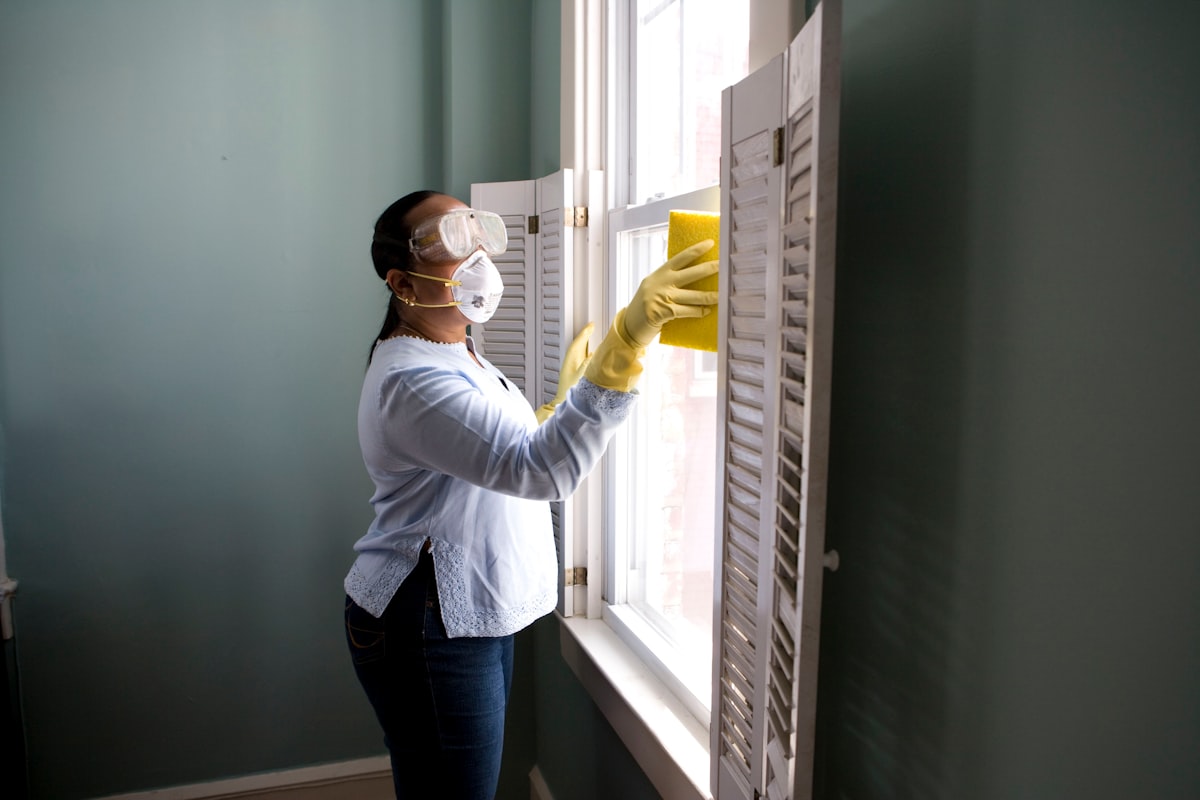
Never bid a commercial cleaning contract without walking the building first. Photos and floor plans from the facility manager are a starting point, not a substitute. You need to see the space, count the restrooms, check the floor types, and identify the complexity factors that move your production rate up or down.
Here’s what to measure and document during the walkthrough:
-
Total gross sq ft vs. cleanable sq ft — Get the building’s gross footage from the facility manager, then subtract mechanical rooms, storage closets, server rooms, and other non-cleanable areas. The difference can be 15–25% of total footage.
-
Restroom count and type — Restrooms clean at 2–3x slower per square foot than open office space. Each restroom stall adds approximately 10–15 minutes of labor per clean. A building with 8 single-stall restrooms takes significantly more labor than one with 2 multi-stall restrooms.
-
Floor types — Carpet, LVP, tile, polished concrete. Each has different cleaning times and equipment requirements. Hard floors with high-gloss finish require buffer/burnisher time on top of standard mopping.
-
Kitchen and break room count — These are time sinks. Appliance cleaning, countertop disinfection, and heavy trash volume add 15–20 minutes per kitchen per clean.
-
Specialty areas — Server rooms (restricted access, anti-static protocols), medical treatment rooms (biohazard disposal), labs (chemical handling). Each one adjusts your production rate downward.
-
Current vendor pain points — Ask the facility manager what their current cleaning company gets wrong. This tells you what to emphasize in your proposal and what tasks to budget extra time for.
-
Access method — Key, code, badge, or on-site contact? After-hours access affects scheduling and crew logistics.
-
Security and compliance requirements — Background checks, escort requirements, HIPAA compliance for medical facilities. These add costs to crew onboarding.
-
Parking and loading access — Can your crew park near the building? Is there a loading dock for supplies? Long walks from the parking lot eat into productive cleaning time.
Take photos of everything during the walkthrough. You’ll reference them when building your scope of work, and they serve as baseline documentation if the client disputes cleaning quality later.
Bid Structures — Pricing by Service Frequency
Cleaning frequency directly affects your per-clean rate. A 5x/week contract costs less per visit than a weekly contract for the same building — and that’s by design, not generosity.
More frequent visits mean less soil accumulation between cleans, shorter per-visit labor times, and a crew that knows the space. Weekly or bi-weekly contracts require more intensive cleaning each visit because dirt, trash, and restroom usage build up between services.
| Frequency | Visits/Month | Per-Clean Rate Adjustment | Why |
|---|---|---|---|
| 5x/week | 20–22 | Lowest per-clean rate | Crew knows the space, minimal buildup |
| 3x/week | 12–13 | 10–15% premium | Moderate soil accumulation between visits |
| Weekly | 4–5 | 20–30% premium | Higher per-visit labor intensity |
| Bi-weekly | 2 | 40–50% premium | Partial deep clean required each visit |
| Monthly | 1 | 60–80% premium | Essentially a deep clean every visit |
For the 10,000 sq ft office example above, a 5x/week contract might bid at $105–$115/clean ($2,310–$2,530/month), while a weekly contract for the same building bids at $131/clean ($524/month). The per-clean rate is lower on the daily contract, but the monthly revenue is 4–5x higher — and the predictable schedule makes crew management simpler.
When presenting frequency options, give the client a tiered proposal with 2–3 frequency choices. Most facility managers appreciate the transparency, and it anchors the conversation around service level rather than just price.
The 5-Part Proposal Structure
A professional proposal separates you from the one-page quote your competitor emailed from their truck. For contracts above $1,000/month, the proposal is a sales document. It should address the facility manager’s concerns, not just list your prices.
1. Executive Summary
One page. State the facility name, proposed start date, and three specific reasons your company is the right fit. Focus on the client’s pain points from the walkthrough — not a generic list of your credentials. If the facility manager mentioned inconsistent restroom cleaning, your executive summary should reference your restroom inspection protocol.
2. Scope of Work
This is the section that prevents disputes. Break tasks by frequency: daily, weekly, monthly, and quarterly. Be explicit in your language. Write “Empty all trash receptacles daily and replace liners” not “handle trash.” Write “Vacuum all carpeted areas using HEPA-filtered equipment” not “vacuum floors.” Vague scope leads to “that wasn’t included” conversations six weeks into the contract.
3. Staffing Plan
Facility managers want to know who will be in their building. Describe your crew: number of cleaners per visit, shift hours, supervisor name and contact info, and any relevant certifications (OSHA training, bloodborne pathogen certification for medical facilities). For after-hours contracts, include your supervisor check-in schedule.
4. Quality Assurance Process
Detail how you handle go-backs, client complaints, and regular inspections. Include your inspection frequency (weekly, bi-weekly), your response time for complaints (24 hours is standard), and any technology you use for quality tracking. This is where mentioning inspection software adds credibility.
5. Pricing Schedule
Present the monthly fee, what’s included, and what triggers an additional charge. Event cleanup, carpet shampooing, window washing, and floor stripping/waxing should be listed as optional add-on services with separate pricing. Show the annual total — facility managers budget annually, not monthly. Include a “Schedule A” appendix with your add-on services menu.
For contracts over $3,000/month, attach a certificate of insurance directly to the proposal. Don’t just reference it — include it. Facility managers share proposals internally, and a missing COI can stall the approval process.
Download our free commercial cleaning bid template — a ready-to-customize proposal document with all five sections, plus a scope of work checklist and pricing calculator. Get the template here.
Software That Handles Commercial Bidding
Spreadsheets work for your first few bids. They stop working when you’re quoting three contracts a week and managing active proposals across multiple facilities.
Jobber{rel=“nofollow sponsored”} stands out for commercial bidding specifically because of its built-in quoting tool. You can build a scope of work with line items, calculate labor based on your rates, add optional services the client can accept or decline, and send a professional proposal — all from one platform. When the client approves, Jobber converts the quote into a scheduled job automatically. For operators juggling multiple bids, that workflow cuts hours of admin time per week. Jobber starts at $39/month for solo operators, with team plans at $169/month for up to 5 users. Build and send proposals with Jobber{rel=“nofollow sponsored”}.
Swept is the industry standard for commercial janitorial operations once you’ve won the contract. Its multilingual crew communication (100+ languages), geofenced clock-in, and inspection tools are purpose-built for managing commercial cleaning crews across multiple locations. Swept doesn’t include a quoting or bidding tool, so you’ll still need a separate system for proposals. For a detailed assessment, see our full Swept review. If you’re evaluating Swept against Janitorial Manager, our Swept vs. Janitorial Manager comparison breaks down the differences in depth.
QuickBooks{rel=“nofollow sponsored”} handles the financial backend — tracking costs per contract, comparing estimated vs. actual labor hours, and generating profit/loss reports by client. If you’re bidding multiple commercial accounts, you need accounting software that can tell you which contracts are actually profitable. QuickBooks integrates with Jobber, so job data flows directly into your books.
For a full comparison of commercial cleaning software options, see our guide to best commercial cleaning software.
Common Bidding Mistakes (and How to Avoid Them)
Five mistakes account for the majority of unprofitable commercial cleaning contracts. Each one is avoidable with better process.
1. Confusing gross sq ft with cleanable sq ft. Bidding on total building size inflates your labor estimate and produces a bid that’s 15–25% higher than it should be. Measure cleanable space during the walkthrough. Subtract mechanical rooms, closets, storage, and any areas excluded from the scope.
2. Ignoring restroom density. A facility with 8 single-stall restrooms scattered across three floors takes roughly 3x longer per square foot than a building with 2 centralized multi-stall restrooms. Restrooms are the single biggest variable in production rate accuracy. Count every stall and factor each one into your labor estimate.
3. Not accounting for mobilization time. Travel to the site, unloading supplies, setup, and breakdown add 15–30 minutes to every visit. On a daily contract with 22 visits per month, that’s 5.5 to 11 hours of unbilled labor if you didn’t include it in your bid. Add a mobilization line item to every estimate.
4. Using a single production rate for all facility types. Medical clinics clean at half the rate of standard offices. Schools with high restroom density clean slower than light industrial spaces. Using 4,000 sq ft/hr as a universal benchmark will produce unprofitable bids on complex facilities and uncompetitive bids on simple ones. Match your production rate to the facility type.
5. Bidding too low to win the first contract. A contract won at break-even is a contract that exhausts your crew and produces no cash for growth. If a prospect’s budget can’t support your cost-plus-margin pricing, walk away. One profitable contract is worth more than three break-even contracts that consume your capacity.
Put the Formula to Work
The math behind commercial cleaning bids isn’t complicated. Production rate, loaded labor cost, overhead, and margin — four variables that determine whether a contract makes you money or costs you money. The operators who build profitable commercial books run these numbers on every bid, adjust for facility-specific complexity, and present proposals that look professional.
If you’re still running bids on spreadsheets, Jobber’s quoting tool{rel=“nofollow sponsored”} automates the process — scope of work, labor calculation, professional proposal, and client approval in one workflow. Start your free Jobber trial{rel=“nofollow sponsored”}.
Next step: Once you’ve dialed in your bidding process, the challenge shifts to actually landing contracts. Read our guide on how to land your first $10K office contract for outreach strategies, proposal follow-up sequences, and the networking channels that produce commercial leads.
Download the free commercial cleaning bid template — a plug-and-play proposal document with scope of work checklist, labor calculator, and pricing schedule. Get it here.
verified Editor's Tip
Bookmark this guide and revisit it as your business grows — different sections become relevant at different stages.
Quick-Reference Overview
| Metric | Industry Average | Top Performers |
|---|---|---|
| Client Retention | 60-70% | 85%+ |
| Profit Margin | 10-15% | 25-35% |
| Employee Turnover | 200%+/yr | <75%/yr |

Top Cleaning Software
Explore our curated reviews of the best software tools for cleaning businesses.
View Full Review arrow_forwardGet More Guides Like This
Join cleaning professionals who read our weekly industry insights.
No spam. Only high-authority cleaning industry data.
Enjoyed This Guide?
Join cleaning professionals who read our weekly industry insights.


